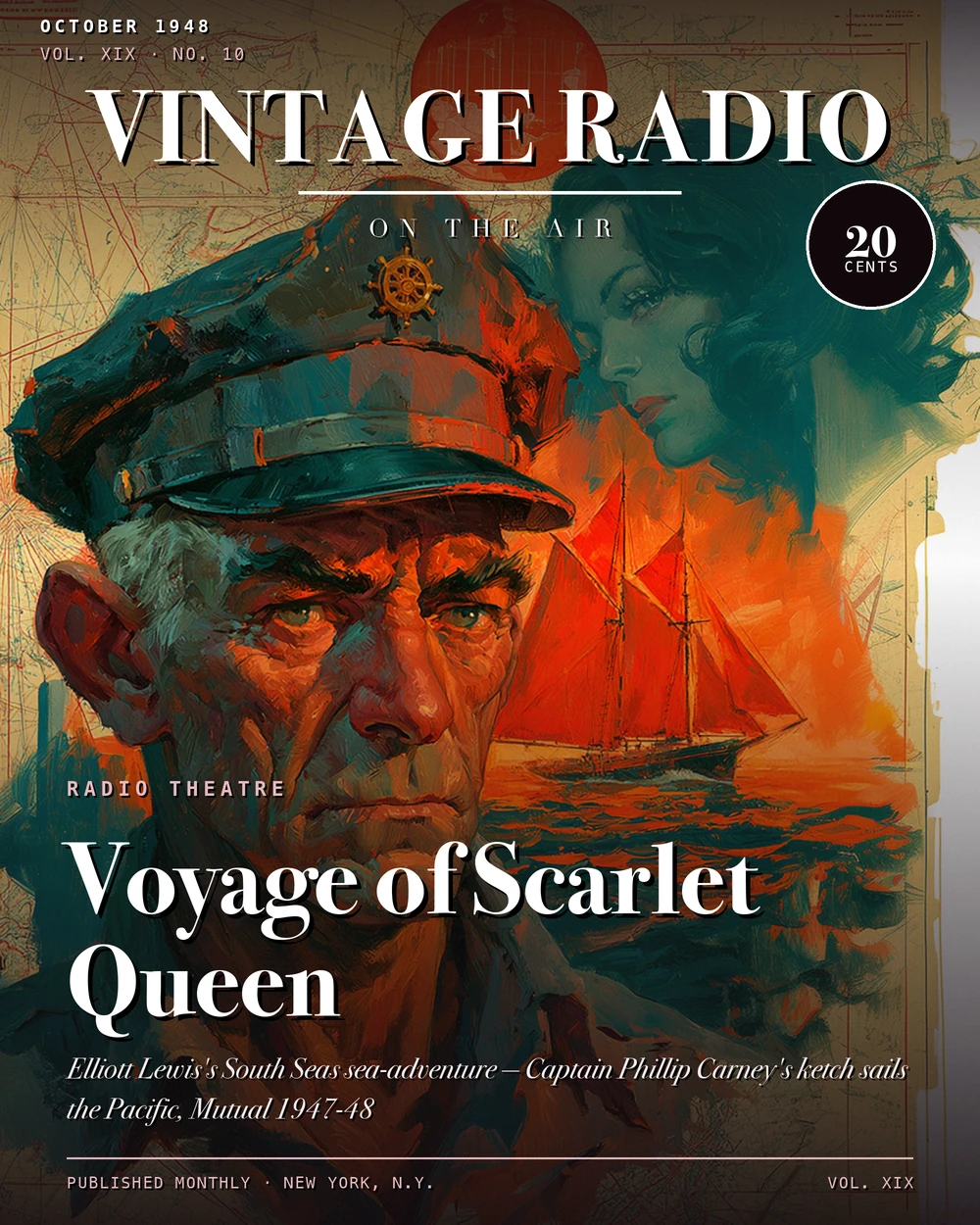
Voyage of Scarlet Queen
The Ship, the Log, and the Setup
What set Voyage of Scarlet Queen apart from the adventure shows crowding the 1947 airwaves wasn't the exotic ports or the colorful villains — it was the frame. Every episode opened with the sounds of the sea rising up and a lookout's sharp cry from the crow's nest, then settled into the voice of Philip Carney reading from his ship's log. Carney, master of the ketch Scarlet Queen, gave the ship's position in degrees and minutes of latitude and longitude — one log entry placed the Scarlet Queen at three degrees, seven minutes north, 104 degrees, two minutes east, departing Singapore — and then closed his opening entry with a line that introduced the title of that week's story. Every episode ended the same way: sea sounds, ship creaks, and Carney's voice signing off: "Ship secured for the night. Signed, Philip Carney, master." That kind of structural consistency is easy to underestimate. It gave the show a rhythm that felt like a genuine voyage.
The episode titles alone tell you something about the writers' sensibility: "The Winchester Rifle and the Ambitious Groom," "The Bubble Dancer and the Buccaneer," "The Barefoot Nymph in the Mother Hubbard Jacket." These aren't the workmanlike titles of a show grinding out product. Writers Gil Doud and Robert Tallman — also credited as Bob Tallman — brought a novelist's instinct for the particular. Both were already co-writing scripts for The Adventures of Sam Spade when they took the assignment, and Doud's other credits ran to Yours Truly Johnny Dollar, Escape, Suspense, Gunsmoke, and Fort Laramie. That background shows in the texture of the writing. Despite being a sea drama, the show's storytelling style bore a striking resemblance to the hard-boiled detective stories dominating the airwaves at the time — a mood that kept the adventure grounded rather than swashbuckling.
Elliott Lewis: Star, Director, and the Reason It Worked
Elliott Lewis held two jobs on Voyage of Scarlet Queen simultaneously: he was both the star and the director of every episode throughout the run. Leonard Maltin, in The Great American Broadcast, noted that Lewis "held down both jobs simultaneously as director and star," and was "completely convincing as seagoing ship's master Philip Carney — never corny or overblown." Radio writer E. Jack Neuman, also quoted in Maltin's book, called Lewis "the greatest actor of them all," adding: "He could break your heart with a word; his timing was impeccable."
Lewis was born November 28, 1917 in New York City and eventually earned the nickname "Mr. Radio" for a career that touched acting, writing, producing, and directing across more than 1,200 radio productions. He married actress Cathy Lewis — who happened to share his surname before they wed — on April 30, 1943. She appeared on Voyage of Scarlet Queen as Henrietta "Hank" Ainley, a recurring love interest for Carney, in two episodes. At the height of their careers they were earning a combined income of $90,000 per year. They divorced in 1958; Lewis later married actress Mary Jane Croft in 1959 and remained with her until his death on May 23, 1990 in Gleneden Beach, Oregon.
Lewis didn't stop performing when radio faded. In 1980 he turned to fiction, producing eight novels about an ex-cop private eye named Fred Bennett; the Los Angeles Times called his debut, Two Heads Are Better, "a striking novelistic debut."
How the Series Came Together
Voyage of Scarlet Queen was created by Command Radio Productions and then purchased for broadcasting by the Mutual network, which premiered the show on July 3, 1947. The series was produced by James Burton. The musical score was composed by Richard Aurandt — full name Richard Dewees Aurandt, also known as Dick Aurandt — a Hammond organist, theater organist, conductor, and radio producer who had been active in San Francisco from around 1920 before moving to the West Coast radio scene. His Dick Aurandt Orchestra provided music for Rocky Jordan, Jeff Regan Investigator, Steve Canyon, The Adventures of Philip Marlowe, and The Green Lama, among others. Sound effects were handled by Ray Kemper, Bill James, and Tom Hanley.
The road to the broadcast cast wasn't direct. The audition episode, recorded in February 1947 and titled "The Death of David Malone," featured Howard Duff as Captain Philip Karney and Lewis as first mate Red Gallagher. Alan Ladd was also approached for the lead role before Lewis ultimately took it. When the show went to air, Ed Max was brought in to play Gallagher, Lewis stepped up to the captain's role, and the pilot's villain, Van Gort, became Constantino in the series. The supporting cast that assembled around Lewis and Max was drawn from Hollywood radio's working pool: William Conrad, Ben Wright, John Dehner, Gloria Blondell, Paul Frees, Virginia Gregg, Jack Kruschen, Roddy McDowall, Alan Reed, Verna Felton, Berry Kroeger, and Barton Yarborough, among others. Yarborough appeared in multiple episodes — when his character was killed off, the writers brought him back as that character's brother.
The captain's surname itself proved slippery. A Billboard review from August 1947 used "Kearney," while the original scripts held in UCLA's Mort Fine collection use "Karney." Both spellings — along with "Carney" — appear across surviving sources.
The Long Arc and the Ports of Call
The first 20 episodes of Voyage of Scarlet Queen form a continuous serial arc, which was unusual for adventure radio of the period. Carney is hired by a Chinese merchant named Ku Chei Kang, owner of the international trading firm "China Traders, Kang and Sons," to deliver a cargo valued at ten million dollars: a complete set of ancient Chinese artifacts spanning every major period of Chinese history, which Kang believes will restore pride to postwar China. Kang himself appears in only one episode, though Carney visits his offices repeatedly. The antagonist driving the plot through episodes one to twenty is Constantino, a Portuguese crime lord whose agents oppose Carney at nearly every port — Constantino himself doesn't appear until episode 21.
A recurring villain named Ah Sin adds texture to the antagonist roster: vain, obese, educated, and ruthless, a Chinese trader who "speaks like Charles Laughton" and surrounds himself with jasmine perfume, with a Texan sidekick named Mangan who carries a pearl-handled frontier pistol. Each episode in the first arc closed with Carney announcing the cumulative miles the Scarlet Queen had traveled from her San Francisco port of call — a small device that gave the serial its sense of actual progress across the ocean. And with one exception across the run, every episode ended with Gallagher offering Carney a drink and Carney answering: "After you, Mate, after you."
The show's episode titles suggest ports of call stretching across Southeast Asia and the Pacific: Shanghai, Manila, Hong Kong, Surabaya, Kobe, Bali, Rabaul, Pango Pango, Singapore. Gallagher himself started the series as an agent working for the villains before switching sides to become Carney's loyal crewman — a character turn that gave the partnership an undercurrent of provisional trust.
Why It Ended and What Came After
Mutual aired the show on Thursdays at 8:30 through November 1947, then moved it to Wednesdays at 10 from December 3 through December 24, then shifted it again to Saturdays at 9:30 in the morning starting January 10, 1948. A show bouncing between time slots that often is usually a show without a sponsor digging in to protect it. Voyage of Scarlet Queen never attracted a commercial sponsor — and Mutual cancelled it in February 1948 after seven months on the air, citing unimpressive ratings. The show could still be heard on scattered stations through the end of summer 1948.
The series ran for 35 broadcast episodes total, and 33 of those survive — episodes 7 and 10 are missing. Two original scripts, "The Barefoot Nymph in the Mother Hubbard Jacket" and "The Ninth Niece in the Street of Weeping Women," are preserved in UCLA Library Special Collections as part of the Mort Fine collection (boxes 51 and 52). A Radio Spirits commercial CD release, with a program guide written by OTR historian Jack French, gathered 18 episodes.
Lewis made one direct attempt to revive the concept after cancellation. On May 6, 1950 he produced an unsold radio pilot titled "The Log of the Black Parrot," retaining Ed Max as a character now renamed Matthew Kinkaid, with Gil Doud directing. The cast included Jack Kruschen, Ben Wright, Lillian Buyeff, Ted Osborne, and Harold Hughes; Walter Schumann handled music direction and Nathan Scott composed the score. The property then circled television twice without landing — Allegro Productions was scheduled to film episodes in 1951, and NBC revived the idea in 1955, but neither effort produced any known finished video. A 1975 TV movie, The Log of the Black Pearl, produced by Jack Webb's Mark VII Ltd. for Universal Television and broadcast on NBC on May 4, 1975, echoed the premise: a stockbroker who inherits an old sailing vessel. It starred Kiel Martin and Ralph Bellamy, was directed by Andrew V. McLaglen, and put Jack Kruschen — a Scarlet Queen alumnus — back into the cast. None of these successors matched what Lewis and his writers had assembled in those 33 surviving half-hours: a sea adventure that took its geography seriously, built a genuine serial arc across twenty episodes, and trusted a hard-boiled sensibility to carry the drama without ever letting the ocean feel like a backdrop.